
2025
Deeper Dialogue and Reflection Through Documentation: Moving From Telling Stories About Children’s Interests to Uncovering Children’s Theories, Ideas, and Strategies
by Susan Stacey
Volume 32, Number 1 | pp. 22–33
Drawing on decades of study of the Reggio Emilia approach, Susan Stacey examines the relationship between pedagogical documentation and reflective practice. She explores documentation as a relational tool that strengthens connections within learning communities and serves as a mirror for educators’ thinking and practice.

2024
The Relationship Between Theory and Practice as a “Dance of Knowledge”
by Daniela Lanzi
Volume 31, Number 3 | pp. 6–9
In this article from Reggio Emilia, pedagogista and pedagogical coordinator Daniela Lanzi reflects on the dynamic relationship between theory and practice in early childhood education. She describes this relationship as a “dance of knowledge,” highlighting how thought, inquiry, and daily practice continuously inform and enrich one another.

2023
Movement in Nature: A Threshold for Knowledge Through Relationships, Connection, and Empathy
by Marcela Caceres-Gelinas, Elisia Wellington, and Michelle Lagunas
Volume 30, Number 1 | pp. 26–45
Based on an in-depth study at Bright Start Child Development Center in Santa Barbara, California, the authors examine how children develop knowledge through movement and encounters with the natural world. Through relationships with trees and other elements of the environment, children use diverse forms of expression to explore, interpret, and deepen their understanding of nature.

2022
Deconstructing Science and Democracy: Making Meaning in a Convoluted Era
by Alex Morgan
Volume 29, Number 1 | pp. 18–33
Alex Morgan reflects on a scientific inquiry project undertaken with uncertainty by children at Boulder Journey School. Through questioning, observation, reflection, analysis, and experimentation, the project illustrates how collaborative research can foster meaning-making while supporting democratic values and participation.

2021
A Partnership with Nature: An Urban School’s Collaborative Study
by Kristin Brizzolara Vazquez & Karen Haigh
Volume 28, Number 1 | pp. 28–45
Drawing on experiences from Velma Thomas Early Childhood Center in Chicago, the authors document a collaborative study of nature conducted by teachers across seven classrooms. Through shared observations and stories developed with educators and a parent educator, the article explores how sustained inquiry can shape a schoolwide culture grounded in relationships with the natural world.

2020
An Invitation to Participate in a Teacher Research Collaborative: Children and Trees in Relationship
by Jeanne Goldhaber
Volume 27, Number 1 | pp. 36–43
Jeanne Goldhaber introduces a collaborative research project developed through the Reggio Inspired Vermont Early Education Team (RIVET). Centered on children’s relationships with trees, the project invites educators to engage in collective inquiry and documentation to deepen understanding of children’s encounters with the living world.
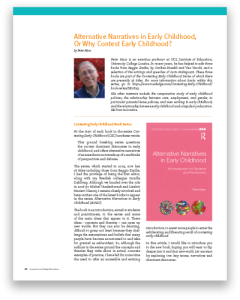
2019
Alternative Narratives in Early Childhood, Or Why Contest Early Childhood?
by Peter Moss
Volume 26, Number 1 | pp. 12–21
Peter Moss presents a case for the Reggio Emilia approach by examining dominant assumptions that shape contemporary early childhood education. He argues for alternative narratives that challenge prevailing institutions and perspectives, emphasizing the importance of interpretation, democracy, and critical reflection in educational practice.
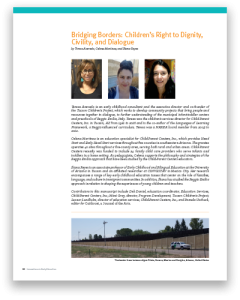
2018
Bridging Borders: Children’s Right to Dignity, Civility, and Dialogue
by Teresa Acevdo, Celena Martinez, and Iliana Reyes
Volume 25, Number 3 | pp. 18–33
In this article, the authors share the lived experiences of children, families, teachers, and communities along the United States–Mexico border. Through stories of daily life and dialogue, they highlight children’s rights to dignity, civility, and participation while offering insight into the realities of life in a border community.